Octocrylene and Homosalate: The Other Chemical UV Filters
When oxybenzone left many sunscreens, octocrylene and homosalate often filled the gap. They have their own open questions worth knowing about.

Key takeaways
- Octocrylene and homosalate are chemical UV filters often used in sunscreens marketed as oxybenzone free.
- Research suggests octocrylene can slowly break down into benzophenone as a product ages.
- The EU now restricts homosalate to face products at a much lower concentration than the US allows.
- Both were absorbed into the bloodstream above the FDA's threshold for further testing in its clinical studies.
When shoppers and lawmakers started turning away from oxybenzone, sunscreen makers did not simply switch to mineral filters. Many reformulated with other chemical filters instead. Two of the most common are octocrylene and homosalate. You will find them in a large share of drugstore sunscreens, including many labeled "oxybenzone free." They are not new or exotic, but in the last several years both have drawn their own scrutiny, and it is worth knowing why before you assume an oxybenzone free label tells the whole story.
What are octocrylene and homosalate?
Octocrylene is a chemical filter that absorbs UVB and some short wave UVA light. Formulators value it for a second reason: it helps stabilize avobenzone, a UVA filter that otherwise breaks down quickly in sunlight. It also helps sunscreens resist water and gives formulas a pleasant, emollient feel.
Homosalate belongs to the salicylate family of UV filters. It absorbs UVB light and also works as a solvent, helping other filters dissolve evenly in a formula. In the US, sunscreen rules permit homosalate at concentrations up to 15 percent, which is among the highest allowed for any filter.
Where they show up
- Lotion, spray, and stick sunscreens, especially "sport" and water resistant formulas
- Daily moisturizers and tinted products with sun protection
- Lip products with sun protection
- Many sunscreens labeled oxybenzone free or "reef friendly"
Label names
Look in the Drug Facts box of US sunscreens. Octocrylene is usually listed simply as octocrylene. Homosalate is listed as homosalate, and you may also see it called homomenthyl salicylate. Other salicylate filters, such as octisalate (ethylhexyl salicylate), often appear alongside it.
What the research and regulators say
Absorption into the body
In the FDA clinical studies published in JAMA in 2019 and 2020, octocrylene and homosalate were among the six chemical filters tested. Both were absorbed into the bloodstream at levels above 0.5 nanograms per milliliter, the FDA's threshold for requiring further toxicology studies. As with oxybenzone, the FDA stressed that this finding does not mean the ingredients are unsafe, only that more data are needed. The agency's 2019 proposed rule placed both filters in the group needing additional safety information.
Octocrylene and benzophenone
The most discussed concern about octocrylene came from a 2021 study that analyzed commercial sunscreens and found benzophenone in products containing octocrylene, with levels that appeared to increase as products aged. The researchers proposed that octocrylene can slowly degrade into benzophenone over time. Benzophenone is classified by IARC as possibly carcinogenic to humans (Group 2B), based mainly on animal studies, and it is also listed under California's Proposition 65. The study had limitations, and more independent testing is needed, but it brought up a practical point: old sunscreen may not be the same product it was when it was made.
Skin allergy
Octocrylene can cause contact and photocontact allergy. Dermatologists have noted that people with a photoallergy to ketoprofen, an anti-inflammatory gel used in some countries, are more likely to react to octocrylene as well. Rates of allergy in the general population appear low, but children have been reported among those affected.
Homosalate in the EU
Homosalate has received closer attention in Europe because of questions about potential hormone activity in laboratory studies. The EU's Scientific Committee on Consumer Safety reviewed it and concluded that the previously permitted 10 percent level was not safe. The EU has since restricted homosalate to face products only, at a substantially lower maximum concentration, and it can no longer be used in body sunscreens or sprays there. That is a notable gap compared with the 15 percent the US still permits. Our article on US vs EU cosmetic rules explains why the two systems often differ.
Environmental questions
Octocrylene has been detected in seawater, sediments, and marine life near popular beaches. Some laboratory research suggests it may affect corals, though, as with oxybenzone, the real world impact compared with warming oceans is debated. Hawaii later passed a law adding octocrylene and avobenzone to its sunscreen restrictions, so it is worth checking current local rules before a beach trip.
Why chemical filters come in teams
No single chemical filter covers the full range of ultraviolet light. UVB rays are the main cause of sunburn, while UVA rays reach deeper into the skin and contribute to tanning, premature skin aging, and skin cancer risk. To earn a "broad spectrum" label, a sunscreen has to protect meaningfully against both. Chemical sunscreens usually get there by stacking filters: avobenzone for UVA, and a combination such as homosalate, octisalate, and octocrylene for UVB.
That stacking has a consequence. A typical chemical sunscreen may contain three to five filters at once, with total active ingredient concentrations that can add up to a substantial share of the formula. When the FDA asks for more safety data on these filters, the question is not just about each ingredient alone but about how much total filter people apply when they use sunscreen generously and often, as dermatologists recommend. Zinc oxide, by contrast, covers both UVA and UVB on its own, which is one reason mineral formulas can have such short ingredient lists.
Who should be most careful
- Children and babies, for whom pediatricians often suggest mineral formulas. See our guide to non toxic skin care for kids.
- Pregnant people who want to reduce absorbed chemicals. Our article on clean beauty during pregnancy has more.
- People who have reacted to ketoprofen gels or to past sunscreens, who may want to discuss octocrylene with a dermatologist.
- Anyone using an old bottle. Sunscreens carry expiration dates for good reason.
How to read sunscreen labels
- Look past "oxybenzone free." Read every active ingredient in the Drug Facts box. Many formulas pair octocrylene, homosalate, octisalate, and avobenzone.
- Check the expiration date, and replace sunscreen that is past it or has been stored in a hot car for a long time.
- Do not trust unregulated claims like "reef safe" or "clean" without checking the actives.
- Consider mineral filters. Zinc oxide is one of the two filters the FDA proposed as generally recognized as safe and effective. Learn more in our article on zinc oxide and our side by side look at mineral vs chemical sunscreen.
- Know the full chemical filter picture. Our article on oxybenzone and octinoxate covers the filters that started this conversation.
A shorter list under the sun
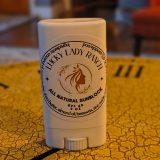
At Lucky Lady Ranch we chose to make a single, simple Mineral Sunblock built on zinc oxide, beeswax, and carrot seed essential oil, with no chemical filters at all. Mineral products tend to feel thicker and can leave a soft white tint, and they should be applied generously and reapplied regularly, especially after swimming or sweating.
Whatever you choose, please keep protecting your skin from the sun. Shade, a wide brim hat, and covering up at midday are some of the most reliable tools there are. We just believe that when you do reach for a product, it should be one whose ingredients you can understand and trust.
From the ranch
Made in small batches, without the ingredients discussed above.
Questions people ask
Is octocrylene safe?
Octocrylene is approved for use in sunscreens in the US and EU, but the FDA has asked for more safety data after finding it is absorbed into the bloodstream. A 2021 study also suggested it can degrade into benzophenone as products age.
Why is homosalate restricted in Europe?
The EU's scientific safety committee concluded the earlier 10 percent limit was not safe, partly because of questions about hormone activity. The EU now allows homosalate only in face products at a much lower concentration.
Does oxybenzone free sunscreen mean it is mineral?
No. Many oxybenzone free sunscreens use other chemical filters such as octocrylene, homosalate, octisalate, and avobenzone. Check the Drug Facts box to see the active ingredients.
Does sunscreen really expire?
Yes. Sunscreens carry expiration dates because filters can lose effectiveness over time. Research on octocrylene also suggests some ingredients may change chemically as a product ages.
What does homosalate do in sunscreen?
Homosalate absorbs UVB light and also acts as a solvent that helps other UV filters dissolve evenly in the formula.
Sources and further reading
- US Food and Drug Administration (FDA), Sunscreen Drug Products for Over-the-Counter Human Use, Proposed Rule (2019)
- Matta MK et al., Effect of Sunscreen Application on Plasma Concentration of Sunscreen Active Ingredients, JAMA (2020)
- Downs CA et al., Benzophenone Accumulates over Time from the Degradation of Octocrylene in Commercial Sunscreen Products, Chemical Research in Toxicology (2021)
- Scientific Committee on Consumer Safety (SCCS), Opinion on Homosalate (2021)
- International Agency for Research on Cancer (IARC), Monographs Volume 101: Benzophenone
- American Contact Dermatitis Society, Contact Allergen Management Program
This guide is for general education and is not medical advice. If you have a skin condition, allergy, or are pregnant or nursing, talk with your doctor or a board certified dermatologist about the products that are right for you.


