Endocrine Disruptors in Personal Care, Explained Simply
Some ingredients in everyday products can interact with the body's hormone system. Here is what that means, what the research does and does not show, and simple ways to cut back.
Key takeaways
- Endocrine disruptors are substances that can interfere with the body's hormone system; the NIEHS and WHO both recognize them as a research priority.
- Personal care ingredients studied for endocrine activity include certain phthalates, some parabens, triclosan, and some chemical UV filters such as oxybenzone.
- Timing and dose matter. Pregnancy, infancy, and puberty are considered more sensitive windows.
- A small intervention study found that switching products for just three days lowered urinary levels of several of these chemicals in teenage girls.
- Choosing fragrance-free or fully disclosed products and simpler formulas is a practical way to reduce exposure.
The phrase "endocrine disruptor" can sound alarming, and it is often used in alarming ways online. The underlying science is more measured, but it is also real enough that health agencies around the world study it closely. This article explains what endocrine disruptors are, which personal care ingredients have been studied for this kind of activity, and what you can do if you would like to reduce your exposure without turning your bathroom upside down.
What Is an Endocrine Disruptor?
Your endocrine system is the network of glands and hormones that regulates growth, metabolism, reproduction, sleep, and mood. Hormones such as estrogen, testosterone, thyroid hormone, and cortisol act as chemical messengers, and they work at very small concentrations.
The National Institute of Environmental Health Sciences (NIEHS) describes endocrine disruptors as natural or human-made chemicals that may mimic, block, or interfere with the body's hormones. A chemical might act like a weak version of estrogen, block a hormone from binding to its receptor, or change how hormones are made or broken down.
Why small doses get attention
For most toxic substances, a larger dose causes a larger effect. Hormone systems can be different. Because hormones work at tiny levels, researchers have asked whether low doses of hormone-active chemicals could have effects that are not predicted by high dose testing. This is still debated, and it is one reason regulators approach these chemicals carefully.
Personal Care Ingredients That Have Been Studied
Not every chemical in a product is an endocrine disruptor, and the evidence for each one varies. These are the groups that come up most in the scientific literature:
- Phthalates. Some phthalates have shown anti-androgen effects in animal studies. Diethyl phthalate (DEP) has historically been used in fragrance blends, where it would not appear on the label.
- Parabens. Several parabens show weak estrogen-like activity in laboratory studies, with longer chain parabens such as butylparaben generally more active than methylparaben. The EU banned five less studied parabens in 2014 and restricted propylparaben and butylparaben.
- Triclosan. An antibacterial agent that has shown effects on thyroid hormone in animal studies. The FDA removed it from over-the-counter antibacterial hand soaps in 2016, citing a lack of evidence that it worked better than plain soap and open safety questions.
- Oxybenzone. Also called benzophenone-3, this chemical sunscreen filter has shown hormone activity in some lab and animal studies. The FDA has said there is not enough data to confirm it is generally recognized as safe and effective.
- Some synthetic musks and certain other fragrance ingredients have been studied for hormone activity, though the evidence is less consistent.
What the Research Shows, and What It Does Not
It helps to separate a few different kinds of evidence.
Lab and animal studies
Much of what we know comes from cell studies and animal studies, often at doses higher than people would get from cosmetics. These studies identify a hazard: something a chemical can do. They do not, by themselves, prove that typical human exposure causes harm.
Human biomonitoring
The Centers for Disease Control and Prevention measures chemicals in blood and urine through its national biomonitoring program. Metabolites of several phthalates and parabens have been detected in a large share of people tested. That tells us exposure is widespread. It does not tell us whether those levels cause health effects.
Human observational studies
Some studies have linked higher levels of certain phthalates, especially during pregnancy, with differences in child development and reproductive outcomes. These associations are taken seriously, but observational studies cannot prove cause and effect on their own, and results are not always consistent.
A real-world intervention
One of the clearest findings for shoppers came from a small study in California published in Environmental Health Perspectives in 2016, known as the HERMOSA study. Teenage girls switched to personal care products labeled free of certain phthalates, parabens, triclosan, and oxybenzone for three days. Their urinary levels of several of these chemicals dropped noticeably. The study did not look at health outcomes, but it showed that product choices can change your exposure, and quickly.
The question of mixtures
Most safety assessments look at one ingredient at a time. Real life is different: many people use a dozen or more personal care products a day, each with small amounts of different chemicals, alongside exposures from food, packaging, and household goods. How those small exposures add up is an active area of research, and it is one reason some scientists favor reducing avoidable exposures where it is easy to do so.
Where regulators stand
The World Health Organization and the UN environment agency (UNEP) have called endocrine disrupting chemicals a global concern. The EU has a formal process for identifying endocrine disruptors and has restricted several cosmetic ingredients. In the US, the FDA continues to consider parabens at current levels safe and has not banned phthalates in cosmetics, although it has reported that most phthalates other than DEP now appear rarely in cosmetics. The honest summary: there is enough evidence to justify caution, especially for sensitive groups, but not enough to say any single product is dangerous.
Who Should Be Most Careful
Researchers talk about "windows of vulnerability," times when the body is developing quickly and hormone signals have outsized effects:
- Pregnancy, when exposures can reach the developing baby. See our guide to clean beauty during pregnancy.
- Infancy and early childhood, when skin is thinner relative to body size. Our article on non toxic skin care for kids covers this.
- Puberty, when hormone levels are changing rapidly.
If you have a hormone-related health condition, a doctor can help you decide which exposures are worth focusing on.
Practical Ways to Lower Your Exposure
- Start with fragrance. Phthalates can hide in "fragrance." Choosing fragrance-free products, or brands that disclose every scent ingredient, sidesteps that uncertainty. Our guide to the fragrance loophole explains why.
- Focus on leave-on products. Lotions, sunscreens, and deodorants stay on skin for hours and cover large areas.
- Consider mineral sunscreen. Zinc oxide and titanium dioxide are the two filters the FDA has proposed as generally recognized as safe and effective.
- Skip antibacterial soaps. Plain soap and water clean hands well, according to the CDC.
- Read the label. Look for the names of parabens, and use our guide to reading ingredient labels as a reference.
- Do not panic. Your body clears many of these chemicals within days. Small, steady changes are enough.
Simple Ingredients, Fewer Questions
At Lucky Lady Ranch, we make our products without parabens, phthalates, triclosan, or synthetic fragrance. That is not because every one of those ingredients has been proven harmful at every dose. It is because we would rather not ask your body to sort it out when plant oils, butters, beeswax, and clays can do the job. Our Mineral Sunblock uses zinc oxide, and our Body Oil is a simple blend of plant oils for daily moisture. Fewer unknowns, one product at a time.
From the ranch
Made in small batches, without the ingredients discussed above.
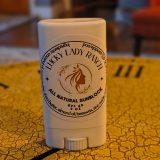 Mineral SunblockZinc oxide in a beeswax balm, without chemical UV filters.
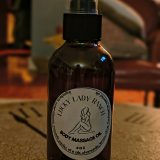 Body OilA silky blend of high quality oils for moisture and massage.
Questions people ask
What are common endocrine disruptors in personal care products?
Ingredients studied for hormone activity include certain phthalates (often hidden in fragrance), some parabens, triclosan, and the sunscreen filter oxybenzone. The strength of the evidence varies by chemical.
Are parabens endocrine disruptors?
Some parabens show weak estrogen-like activity in lab studies, with longer chain parabens like butylparaben more active. The FDA considers parabens safe at current use levels, while the EU has banned some and restricted others.
Can switching products lower my exposure to endocrine disruptors?
Research suggests yes. A 2016 study of teenage girls found that switching to products without certain phthalates, parabens, triclosan, and oxybenzone for three days lowered urinary levels of several of those chemicals.
How long do endocrine disruptors stay in the body?
It depends on the chemical. Phthalates and parabens are generally broken down and excreted within hours to days, which is why exposure levels respond quickly to product changes. Some other chemicals persist much longer.
Are natural products free of endocrine disruptors?
Not necessarily. Some plant compounds have hormone activity too, and natural is not a regulated term. Reading the full ingredient list is more reliable than trusting a label claim.
Sources and further reading
- National Institute of Environmental Health Sciences (NIEHS), Endocrine Disruptors
- World Health Organization and UNEP, State of the Science of Endocrine Disrupting Chemicals 2012
- Harley KG et al., Reducing Phthalate, Paraben, and Phenol Exposure from Personal Care Products in Adolescent Girls (HERMOSA Intervention Study), Environmental Health Perspectives, 2016
- Centers for Disease Control and Prevention (CDC), National Report on Human Exposure to Environmental Chemicals
- US Food and Drug Administration (FDA), Phthalates in Cosmetics
- US Food and Drug Administration (FDA), Parabens in Cosmetics
This guide is for general education and is not medical advice. If you have a skin condition, allergy, or are pregnant or nursing, talk with your doctor or a board certified dermatologist about the products that are right for you.